




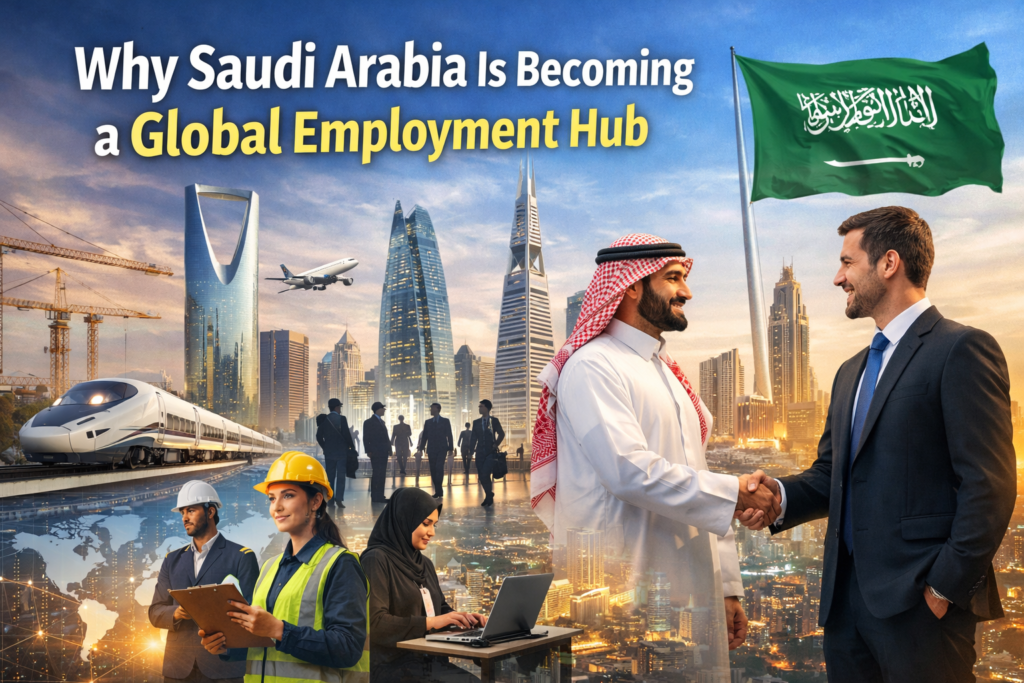
Something extraordinary is happening in Saudi Arabia. From the bustling streets of Riyadh to the futuristic construction zones of NEOM, from the healthcare facilities of Jeddah to the entertainment megaprojects of Qiddiya, the Kingdom is experiencing a talent revolution that’s positioning it as the Middle East’s premier employment destination. For business leaders, HR directors, and C-level executives across the globe, understanding this transformation isn’t just interesting, it’s strategically essential.
The numbers tell a compelling story. Female workforce participation has surged from 17.4 percent in 2017 to 36.3 percent in early 2025. The non-oil economy now accounts for 76 percent of GDP, growing at 4.5 percent annually. Unemployment has dropped from 12.3 percent in 2016 to 7.1 percent in 2024. These aren’t modest improvements; they represent fundamental economic restructuring that creates unprecedented demand for talent across every industry sector.
For organizations seeking to establish or expand operations in Saudi Arabia, or for companies looking to tap into the Kingdom’s emerging talent ecosystem, the question is no longer whether to engage with this market but how to do so strategically. Professional recruitment agencies operating across Riyadh, Jeddah, Dammam, Mecca, Medina, and other major Saudi cities have become essential partners in navigating this transformation, providing the expertise, networks, and compliance knowledge that turn opportunity into operational reality.
The Vision 2030 Revolution: Economic Transformation at Unprecedented Scale
Saudi Arabia’s Vision 2030 initiative represents one of the most ambitious national transformation projects ever undertaken. Launched in 2016, this comprehensive framework aims to diversify the Kingdom’s economy beyond hydrocarbons, creating a vibrant society, thriving economy, and ambitious nation built on three strategic pillars.
From Oil Dependency to Economic Diversification
Historically, oil revenues dominated Saudi Arabia’s economic landscape, accounting for approximately 75 percent of fiscal revenue and 40 percent of GDP. This dependency created vulnerability to global commodity price fluctuations and limited employment opportunities in non-energy sectors. Vision 2030 deliberately inverts this equation, targeting a knowledge-based economy where diverse industries create sustainable employment.
The results by 2026 demonstrate remarkable progress. Non-oil GDP growth reached 4.93 percent in 2023, compared to just 1.82 percent in 2016. The non-oil sector’s contribution to GDP crossed the historic 50 percent threshold and continues climbing toward Vision 2030’s targets. This structural shift creates employment demand across sectors that barely existed in Saudi Arabia a decade ago.
For recruitment agencies and employers, this diversification translates to talent needs spanning renewable energy, technology, tourism, entertainment, healthcare, education, advanced manufacturing, and financial services. Each sector requires specialized recruitment strategies, industry-specific networks, and deep understanding of both technical requirements and cultural fit considerations unique to Saudi Arabia.
Giga-Projects: Physical Manifestation of Transformation
Vision 2030’s most visible elements are the giga-projects reshaping Saudi Arabia’s physical and economic landscape. These aren’t traditional infrastructure developments; they’re transformative initiatives designed to establish entirely new industries and urban ecosystems.
NEOM: The Future City Spanning 26,500 square kilometers along the Red Sea, NEOM represents perhaps the world’s most ambitious urban development project. THE LINE, a 170-kilometer linear city accommodating 9 million residents with zero cars and 100 percent renewable energy, exemplifies the project’s revolutionary approach. NEOM is projected to contribute $48 billion to Saudi GDP by 2030 while generating over 380,000 direct employment opportunities.
The recruitment implications are staggering. NEOM requires urban planners, sustainable energy experts, AI specialists, biotechnology researchers, hospitality professionals, construction workers, and hundreds of other specialized roles. Many positions demand skills at the intersection of multiple disciplines, sustainable architecture that integrates smart city technology, for example, or hospitality management that understands both luxury service and environmental conservation.
The Red Sea Project: Luxury Tourism Reimagined Covering 28,000 square kilometers along Saudi Arabia’s western coast, the Red Sea Project establishes the Kingdom as a premier global tourism destination. With 50 resorts across 22 islands, the project prioritizes environmental regeneration alongside luxury experiences, creating over 35,000 jobs in hospitality, tourism, and cultural sectors.
Recruitment for the Red Sea Project requires understanding both international hospitality standards and Saudi cultural context. Hotels need multilingual staff with luxury service expertise. Conservation initiatives require environmental specialists familiar with Red Sea ecosystems. Entertainment venues need creative professionals who can design experiences that appeal to global travelers while respecting local values.
Qiddiya: Entertainment, Sports, and Arts Capital Spanning 334 square kilometers near Riyadh, Qiddiya becomes Saudi Arabia’s entertainment epicenter, featuring theme parks, sports facilities, cultural venues, and residential communities. The project targets both domestic tourism (Saudis spend $12.53 billion annually on international entertainment) and international visitors, with expected contributions of $4.53 billion to GDP by 2030 and 57,000 new jobs.
Theme park operations, sports facility management, event coordination, food and beverage services, retail management, and creative services all require specialized talent pipelines. Qiddiya’s proximity to Riyadh creates unique recruitment dynamics, allowing companies to tap into the capital’s existing talent base while requiring specialized entertainment industry expertise rarely found in the Kingdom previously.
ROSHN: Revolutionizing Residential Development Targeting 70 percent homeownership across Saudi Arabia by 2030, ROSHN will construct over 400,000 homes and community facilities across 200,000 square kilometers. This massive residential expansion creates sustained demand for construction workers, civil engineers, urban planners, property managers, and community service professionals.
Unlike temporary construction projects, ROSHN’s scale supports long-term employment, allowing recruitment agencies to develop sustained talent pipelines rather than project-specific placements. The homeownership focus also creates secondary employment in mortgage services, real estate, home maintenance, and community management.
Labor Market Reforms: Creating Employment Flexibility
Vision 2030’s success depends not just on economic diversification but on fundamental labor market reforms that increase flexibility, protect worker rights, and align employment practices with international standards.
The Labor Reform Initiative: Enhanced Worker Mobility
Prior to recent reforms, expatriate workers in Saudi Arabia faced significant mobility constraints. Employment was tied to specific sponsors, exit and re-entry visas required employer approval, and job changes involved complex administrative processes. These restrictions created inefficiencies and occasionally enabled exploitative practices.
The Labor Reform Initiative, fully implemented through the Qiwa platform since May 2025, transformed this landscape. Expatriate workers now enjoy greater freedom to change employers without sponsor consent, manage exit and re-entry visas through government platforms, and access streamlined administrative processes for job transfers. These changes align Saudi Arabia with international labor standards while creating a more competitive employment market.
For recruitment agencies, these reforms mean increased placement opportunities as talent circulates more freely within the Kingdom. Workers who previously stayed in suboptimal positions due to transfer difficulties now actively seek better opportunities. Companies can attract talent from competitors based on compensation, working conditions, and career development rather than navigating complex sponsor transfer requirements.
The Qiwa Digital Platform: Centralized Employment Management
The Qiwa platform represents Saudi Arabia’s digital transformation of labor administration. Every employment contract, work visa, salary payment, and compliance certificate now flows through this centralized system, creating unprecedented transparency and efficiency.
For employers and recruitment agencies, Qiwa proficiency has become essential. The platform handles job vacancy posting, candidate documentation verification, employment contract registration, work permit issuance, wage protection system compliance, Saudization status monitoring, and government reporting requirements. Recruitment agencies that master Qiwa integration provide immense value by handling these technical complexities on behalf of clients.
The platform serves over 14.5 million registered users and has processed 11 million employment contracts, making it the authoritative source of Saudi labor market data. Recruitment agencies leverage this data to benchmark salaries, identify talent availability, track industry hiring trends, and ensure compliance with evolving regulations.
Saudization Strategy: Balancing Nationalization and Growth
Saudization, the policy of increasing Saudi national employment in the private sector, creates both opportunities and challenges. The Nitaqat program classifies companies into color-coded categories (red, yellow, green, platinum) based on their Saudi national employment percentage relative to industry benchmarks.
Companies in green or platinum categories access preferential treatment including streamlined visa processing, expedited government services, and eligibility for government contracts. Red category companies face restrictions on visa issuance, employee transfers, and government procurement participation. These incentives create strong compliance motivation.
Recent updates expanded Saudization requirements to 269 professions, with specific targets varying by industry sector. Pharmacy, dentistry, engineering, and accounting face higher localization percentages. Construction, hospitality, and certain specialized industries receive more flexibility while still progressing toward nationalization goals.
For recruitment agencies, Saudization creates dual opportunities. First, developing Saudi national talent pipelines through partnerships with universities, vocational training centers, and graduate development programs. Second, strategically placing expatriate professionals in roles where international expertise remains essential while ensuring overall company compliance with Nitaqat requirements.
The approximately 920,000 additional jobs needed by 2030 to accommodate demographic shifts won’t materialize automatically. Strategic workforce planning that balances Saudization compliance with operational requirements becomes competitive advantage rather than mere regulatory obligation.
Industry-Specific Transformation: Sector-by-Sector Employment Growth
Vision 2030’s economic diversification creates distinct employment dynamics across different industries, each requiring specialized recruitment approaches.
Technology and Digital Innovation
Saudi Arabia is positioning itself as a regional technology hub, with investments in artificial intelligence, cybersecurity, fintech, e-commerce, smart city infrastructure, and cloud computing. The Kingdom’s young demographic (70 percent under 35) provides natural advantages in technology adoption and digital innovation.
Recruitment demand encompasses software developers proficient in AI, machine learning, and blockchain; cybersecurity specialists protecting critical infrastructure; data scientists building analytics capabilities; cloud architects designing scalable systems; fintech innovators developing Islamic banking technology; and digital transformation consultants modernizing traditional industries.
Many positions require intersection expertise, fintech developers must understand both banking regulations and blockchain technology, for example. Smart city planners need urban design knowledge plus IoT and data analytics expertise. This complexity rewards recruitment agencies with both technical understanding and industry networks.
Healthcare and Medical Services
Healthcare expansion under Vision 2030 targets world-class medical facilities across the Kingdom. New hospitals, specialized treatment centers, medical research facilities, and preventive health programs create sustained demand for medical professionals.
Recruitment encompasses physicians across all specialties, registered nurses with international certifications, allied health professionals (physiotherapists, radiologists, lab technicians), healthcare administrators managing complex facilities, medical researchers advancing Saudi healthcare capabilities, and pharmaceutical specialists supporting domestic drug development.
Saudi Commission for Health Specialties licensing requirements add complexity. International medical credentials require verification and often equivalency examinations. Recruitment agencies specializing in healthcare navigate these regulatory requirements, coordinating credential verification, licensing examinations, and employment placement in integrated processes that reduce time-to-hire.
Tourism and Hospitality
Perhaps no sector exemplifies Vision 2030’s diversification more dramatically than tourism. Previously oriented almost exclusively toward religious pilgrimage, Saudi Arabia now develops luxury tourism, eco-tourism, entertainment tourism, and cultural heritage tourism targeting international visitors.
The Red Sea Project, NEOM’s luxury resorts, Qiddiya’s entertainment venues, and heritage site development in Diriyah, AlUla, and Jeddah’s historic district create massive hospitality employment. Hotel managers, chefs, sommeliers, concierges, tour guides, event coordinators, spa therapists, and customer service specialists all require recruitment.
Cultural sensitivity training becomes essential. Service professionals must deliver international luxury standards while respecting Saudi cultural values. Multilingual capabilities (Arabic, English, plus Mandarin, Hindi, or European languages) expand throughout the industry. Recruitment agencies provide not just placement but cultural orientation supporting successful integration.
Renewable Energy and Sustainability
Saudi Arabia’s renewable energy targets include generating 50 percent of electricity from renewable sources by 2030, establishing green hydrogen production capacity, developing carbon capture technology, and positioning the Kingdom as a sustainability leader despite its oil heritage.
Solar energy engineers, wind power technicians, energy storage specialists, green hydrogen researchers, sustainability consultants, environmental impact assessors, and carbon capture engineers all experience growing demand. The Saudi Green Initiative and Middle East Green Initiative create framework for these opportunities.
Renewable energy recruitment often requires international talent attraction. Many positions demand experience with technologies or projects that don’t yet exist at scale in Saudi Arabia. Recruitment agencies facilitate international placements, managing visa processes, relocation logistics, and cultural integration for specialists relocating to Riyadh, Jeddah, or project-specific locations like NEOM.
Advanced Manufacturing
Manufacturing diversification targets aerospace components, automotive parts, pharmaceuticals, electronics, and advanced materials. The goal is reducing import dependency while creating export-oriented industries that generate employment and foreign currency.
Industrial engineers, quality control specialists, production managers, supply chain experts, materials scientists, and skilled tradespeople (machinists, welders, electricians) all find growing opportunities. Manufacturing’s technical nature rewards recruitment agencies with industry-specific knowledge who can assess technical competencies accurately.
Education and Training
Preparing Saudi youth for Vision 2030’s economy requires educational transformation. New universities, vocational training centers, corporate training programs, and lifelong learning initiatives all require educational professionals.
University professors, vocational instructors, corporate trainers, curriculum developers, educational technology specialists, and education administrators experience robust demand. The Human Capability Development Program specifically targets aligning education with private sector needs, creating opportunities for educators who bridge academic and practical training.
Financial Services and Fintech
Riyadh is developing into a regional financial hub, competing with Dubai, Abu Dhabi, and Doha. Islamic finance innovation, wealth management, private equity, venture capital, and fintech applications all expand rapidly.
Financial analysts, investment managers, fintech developers, regulatory compliance specialists, wealth advisors, and Islamic finance scholars all find opportunities. The Kingdom’s focus on attracting international investment creates demand for professionals with global experience who can navigate both Western and Islamic financial frameworks.
Demographic Advantages: Youth, Education, and Gender Equality
Saudi Arabia’s demographic profile provides natural advantages in its employment transformation, though realizing these advantages requires continued policy focus.
Youth Demographics and Economic Energy
With 70 percent of Saudi citizens under 35, the Kingdom possesses enormous economic potential. This young demographic seeks not just employment but meaningful work, international exposure, and career progression. Vision 2030 directly addresses these aspirations through economic diversification that creates knowledge-economy opportunities beyond traditional sectors.
Youth employment programs, entrepreneurship support, startup funding, and international education scholarships all aim to channel youthful energy into productive economic activity. For recruitment agencies, understanding generational preferences becomes essential. Young Saudi professionals prioritize career development, company culture, work-life balance, and international exposure differently than previous generations.
Educational Investment and Skills Development
The Human Capability Development Program restructures education to align with Vision 2030 employment needs. STEM education expansion, vocational training emphasis, international university partnerships, corporate training integration, and lifelong learning frameworks all aim to build competitive workforce capabilities.
Measurable outcomes include graduate employability rates, private sector training placements, startup participation, and skills certification achievement. These metrics ensure educational investment translates to employment outcomes rather than theoretical knowledge disconnected from market demand.
Recruitment agencies increasingly partner with educational institutions, providing market intelligence on skills demand, facilitating internship programs, conducting campus recruitment, and developing graduate training programs. These partnerships create talent pipelines that reduce recruitment costs while improving candidate quality.
Women’s Workforce Participation: Transformative Progress
Female workforce participation represents one of Vision 2030’s most dramatic transformations. The increase from 17.4 percent in 2017 to 36.3 percent in early 2025 unlocks enormous economic potential while advancing gender equality.
Policy reforms enabling this progress include legal protections against workplace discrimination, flexible work arrangements supporting family responsibilities, transportation improvements addressing mobility constraints, childcare support reducing parental burden, and cultural messaging normalizing women’s professional participation.
For recruitment agencies, women’s workforce expansion creates both opportunity and responsibility. Developing female talent pipelines, ensuring equitable placement practices, advising clients on inclusive workplace policies, and supporting career development for women professionals all become essential service elements.
Industries particularly benefiting from female participation include healthcare, education, financial services, technology, retail, and professional services. Some sectors, notably construction and certain manufacturing roles, maintain more traditional gender distributions, though even these gradually evolve.
Global Talent Attraction: Positioning Saudi Arabia Competitively
Vision 2030’s success requires not just developing domestic talent but attracting international expertise. Saudi Arabia increasingly competes globally for skilled professionals, particularly in emerging technologies, specialized industries, and leadership positions.
Competitive Compensation and Benefits
Saudi Arabia offers tax-free income, a significant advantage over most global markets. Salaries in Riyadh, Jeddah, and Dammam often exceed those in comparable regional cities when tax benefits are considered. Accommodation allowances, transportation benefits, annual leave exceeding Western norms, and relocation support packages enhance total compensation.
For recruitment agencies advising international candidates, presenting total compensation requires sophisticated analysis. A Riyadh salary may appear lower than London or New York equivalents, but tax-free status, lower living costs, and benefits packages often result in superior net compensation and savings potential.
Quality of Life Improvements
Recent years have seen dramatic improvements in Saudi Arabia’s lifestyle offerings. Entertainment options including cinemas, concerts, and sporting events; dining diversity with international cuisines and upscale restaurants; cultural attractions such as museums, heritage sites, and art galleries; recreational facilities including beaches, resorts, and leisure clubs; and family-friendly environments with parks, malls, and educational facilities all enhance expatriate life quality.
Riyadh’s transformation into a modern capital, Jeddah’s cosmopolitan coastal lifestyle, and emerging destinations like NEOM’s luxury residential communities compete effectively with regional alternatives. Recruitment agencies facilitate informed decisions by providing accurate lifestyle information, arranging pre-relocation visits, and connecting candidates with current expatriate communities.
Career Development and Global Experience
Working on Saudi Arabia’s transformative projects provides unique career development. Professionals gain experience on unprecedented scale projects, develop cross-cultural competencies, build regional networks valuable for future opportunities, and acquire specialized expertise in emerging industries.
For career-focused professionals, Saudi Arabia offers opportunities rarely available elsewhere. Where else can urban planners design entirely new cities? Environmental specialists lead regenerative tourism projects? Entertainment professionals launch new theme parks and sports facilities? These experiences create competitive career differentiation.
Recruitment Industry Evolution: Meeting Transformed Demands
Saudi Arabia’s employment transformation creates parallel evolution in recruitment industry practices, capabilities, and value propositions.
From Transactional to Strategic Partnership
Traditional recruitment focused on filling specific vacancies with qualified candidates. This transactional model proves insufficient for Vision 2030’s complexity. Modern recruitment agencies in Saudi Arabia function as strategic workforce partners providing talent market intelligence, workforce planning consultation, Saudization strategy development, compliance advisory services, and long-term talent pipeline creation.
For organizations establishing operations in Riyadh, Jeddah, Dammam, Mecca, Medina, or other Saudi cities, recruitment agencies provide market entry expertise, regulatory navigation, cultural integration support, and accelerated hiring that would take months or years to develop internally.
Technology Integration and Data Analytics
Recruitment technology has advanced dramatically. AI-enhanced candidate matching, automated compliance tracking, real-time labor market analytics, video interviewing platforms, and integrated applicant tracking systems all improve efficiency and quality.
Leading recruitment agencies leverage technology while maintaining human judgment for cultural fit assessment, career counseling, client relationship management, and complex negotiation. Technology handles volume and compliance; people handle nuance and strategy.
Specialized Industry Expertise
Generic recruitment approaches fail in specialized industries. Healthcare recruitment requires understanding of licensing requirements, medical credentials verification, and clinical specialization distinctions. Technology recruitment demands assessment of specific programming languages, cloud platforms, and emerging technical skills. Construction recruitment needs safety certification verification, trade skills evaluation, and project-specific experience assessment.
Recruitment agencies develop vertical expertise in high-demand sectors, building specialized teams with industry backgrounds, maintaining sector-specific candidate networks, understanding technical requirements deeply, and providing consultative industry insights. This specialization creates competitive differentiation and superior client outcomes.
Compliance Expertise as Core Value
Saudi Arabia’s regulatory environment demands compliance expertise across multiple dimensions: Qiwa platform processes, Nitaqat category management, work visa procedures, wage protection system requirements, labor law adherence, and documentation standards. Non-compliance creates operational disruptions, financial penalties, and reputational damage.
Professional recruitment agencies absorb this complexity, maintaining current knowledge of regulatory changes, ensuring every placement meets compliance requirements, handling documentation with precision, and representing clients in government interactions. This expertise converts regulatory burden into strategic advantage.
Why Prime Resources: Your Strategic Recruitment Partner Across Saudi Arabia
Understanding Saudi Arabia’s emergence as a global employment hub is one thing; successfully navigating this landscape to build high-performing teams is another entirely. Prime Resources has established itself as the recruitment agency of choice for businesses across Riyadh, Jeddah, Dammam, Mecca, Medina, Al Jubail, and Tabuk by delivering precisely the expertise, networks, and commitment that Vision 2030 opportunities demand.
Deep Market Presence Across All Major Cities
Our physical presence in Saudi Arabia’s key business centers provides more than geographic coverage; it delivers genuine market intelligence. Our Riyadh team understands the capital’s government sector dynamics, corporate headquarters culture, and talent availability. Our Jeddah recruiters know the western region’s commercial ecosystem, port-related industries, and Red Sea Project opportunities. Our Dammam specialists navigate the Eastern Province’s oil and gas heritage while supporting industrial diversification.
This distributed presence ensures we access local talent pools, understand regional salary expectations, maintain relationships with area universities and training centers, and respond quickly to client needs regardless of location.
Multi-Industry Recruitment Excellence
Vision 2030’s diversification demands recruitment agencies with genuine multi-industry capability. Prime Resources maintains specialized recruitment teams across oil and gas, construction and infrastructure, healthcare and medical services, hospitality and tourism, information technology and digital services, engineering and technical specialties, education and training, manufacturing and industrial sectors, banking and financial services, and retail and customer service.
Each team combines technical understanding with recruitment expertise. Our healthcare recruiters understand medical licensing requirements. Our technology team assesses programming proficiency. Our construction specialists evaluate trade certifications and safety qualifications. This depth ensures accurate candidate evaluation and client-role matching.
Proven Giga-Project Experience
Saudi Arabia’s giga-projects create unique recruitment challenges requiring scale, speed, and quality simultaneously. Prime Resources has successfully supported NEOM recruitment initiatives, Red Sea Project hospitality staffing, Qiddiya entertainment talent acquisition, ROSHN construction and community services hiring, and infrastructure project engineering placements.
Giga-project recruitment demands capabilities most agencies lack: ability to mobilize large candidate volumes quickly, coordination across multiple hiring managers and project phases, international candidate sourcing and relocation management, compliance handling for thousands of simultaneous placements, and sustained engagement across multi-year project timelines.
Saudization Strategy and Compliance Leadership
Navigating Nitaqat requirements while maintaining operational excellence requires strategic workforce planning that few recruitment agencies provide. Prime Resources offers comprehensive Saudization services including current status assessment and category optimization, strategic planning for achieving green/platinum status, Saudi national talent pipeline development, training program coordination with educational institutions, ongoing monitoring and compliance reporting, and Ministry of Human Resources and Social Development representation.
Our compliance team tracks regulatory changes daily, ensuring clients benefit from our knowledge investment rather than risking penalties from outdated practices.
International Sourcing Capabilities
While our primary focus is Saudi Arabia, many positions require international expertise recruitment. Our global networks enable candidate sourcing from key talent markets across Asia, Europe, North America, Africa, and other GCC countries. We manage the complete international recruitment lifecycle including candidate identification and assessment, credential verification and licensing coordination, visa processing and documentation, relocation logistics and family support, and cultural orientation and integration programs.
International placements require particular attention to candidate expectations, family considerations, cultural adaptation, and career development to ensure long-term success rather than costly early turnover.
Technology-Enabled Recruitment Excellence
Prime Resources combines human expertise with technological capability. Our proprietary recruitment platform integrates seamlessly with Qiwa, provides real-time pipeline visibility for clients, automates compliance monitoring and alerts, generates comprehensive analytics and reporting, and maintains secure candidate and client data management.
Technology enables efficiency and transparency while our recruiters provide judgment, relationship management, and strategic counsel that no software can replicate.
The Strategic Imperative: Why Partnership Matters Now
Saudi Arabia’s employment transformation creates a time-sensitive strategic window. Organizations that establish effective recruitment partnerships now position themselves for sustained competitive advantage. Those that delay face escalating talent competition, rising costs, compliance risks, and operational constraints.
First-Mover Advantages in Talent Markets
Early entrants to growing markets typically secure better talent at lower costs than later arrivals. As more companies compete for Saudi Arabia’s expanding talent pool, compensation expectations rise, candidate selectivity increases, and recruitment complexity intensifies. Organizations establishing presence now benefit from relatively favorable conditions that won’t persist indefinitely.
Building Institutional Knowledge
Understanding Saudi Arabia’s business culture, regulatory environment, talent dynamics, and operational realities requires time and experience. Organizations that engage now begin accumulating institutional knowledge that creates sustained advantages. Recruitment partnerships accelerate this learning, providing market intelligence and cultural guidance that would take years to develop independently.
Securing Strategic Recruitment Capacity
The best recruitment agencies maintain finite capacity. As Vision 2030 projects accelerate, demand for recruitment services will exceed quality supply. Organizations that establish recruitment partnerships now secure priority access to scarce expertise, dedicated recruiter attention, and preferential treatment during high-demand periods.
Alignment with National Transformation
Saudi Arabia’s government actively supports businesses contributing to Vision 2030 objectives. Organizations that demonstrate commitment to the Kingdom’s transformation through substantial hiring, Saudization investment, and long-term presence benefit from governmental goodwill, expedited approvals, and partnership opportunities that less-committed organizations don’t receive.
Taking Action: Your Path Forward
For business leaders, HR directors, and C-level executives evaluating Saudi Arabian opportunities, the question isn’t whether this market merits attention but how to engage strategically and effectively.
Begin with honest assessment of your current position. Are you already operating in Saudi Arabia with established teams, or considering market entry? Do you need executive-level expertise, specialized professionals, or large-volume hiring? Are you confident in your Saudization compliance, or uncertain about current status? Can your HR team manage Saudi recruitment complexities, or would partnership provide better outcomes?
These questions reveal whether immediate action, strategic planning, or market exploration represents the right approach. What’s clear is that Saudi Arabia’s emergence as a global employment hub creates opportunities that won’t remain unclaimed. The Kingdom’s transformation is happening with or without any individual organization’s participation. The question is whether you’ll be part of shaping this transformation or merely observing it.
Partner with Prime Resources: Transform Opportunity into Achievement
Prime Resources brings decades of combined recruitment experience to organizations across Saudi Arabia and beyond. Our comprehensive service portfolio addresses every talent acquisition challenge you face, from executive search and leadership recruitment to large-scale project hiring, from Saudization strategy to complete recruitment process outsourcing.
We don’t just fill positions; we build strategic talent partnerships that support your growth objectives while ensuring flawless compliance with Saudi Arabia’s evolving regulatory environment. Our clients in Riyadh, Jeddah, Dammam, Mecca, Medina, Al Jubail, and Tabuk trust us because we deliver what we promise: exceptional candidates, rapid placement, complete compliance guidance, and genuine partnership.
Whether you need to establish operations in Saudi Arabia, expand existing teams, recruit for giga-projects, develop Saudi national talent pipelines, or navigate the Kingdom’s employment transformation, Prime Resources provides the expertise, networks, and commitment that convert Vision 2030’s opportunities into your organizational success.
Contact Prime Resources today to discuss your specific recruitment requirements. Discover how our strategic approach to talent acquisition can position your organization at the forefront of Saudi Arabia’s emergence as the Middle East’s premier employment hub.
The future of work in the Middle East is being written in Saudi Arabia today. The only question is whether your organization will help write this future or merely read about it after others have claimed the opportunities. Let Prime Resources ensure you’re among the authors, not the audience.
